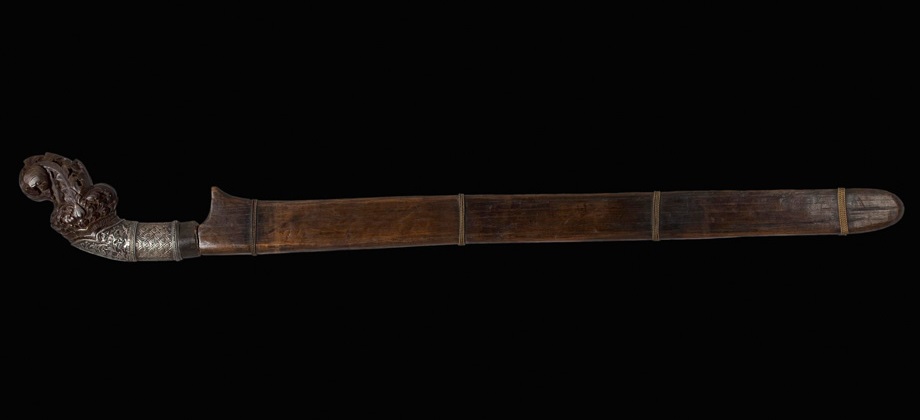
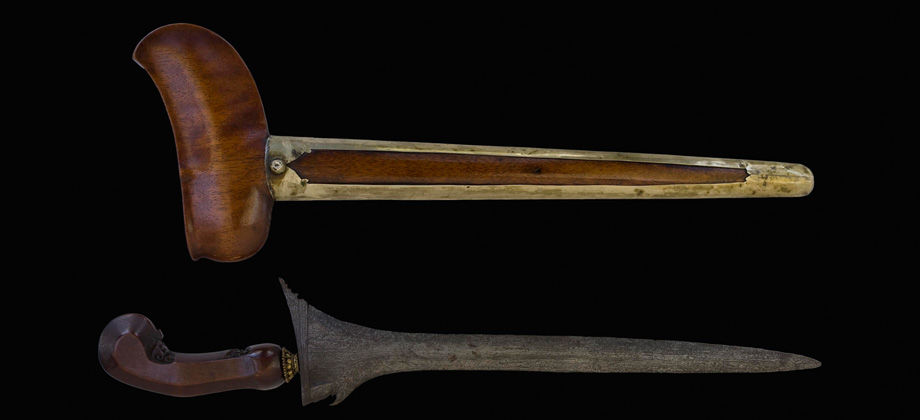
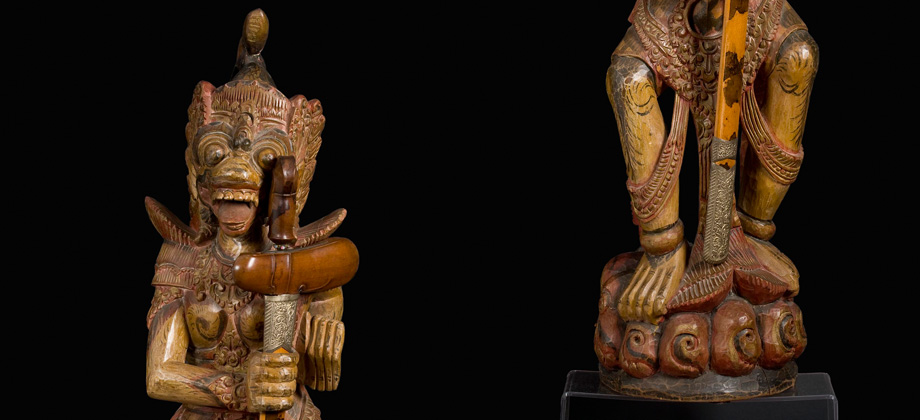
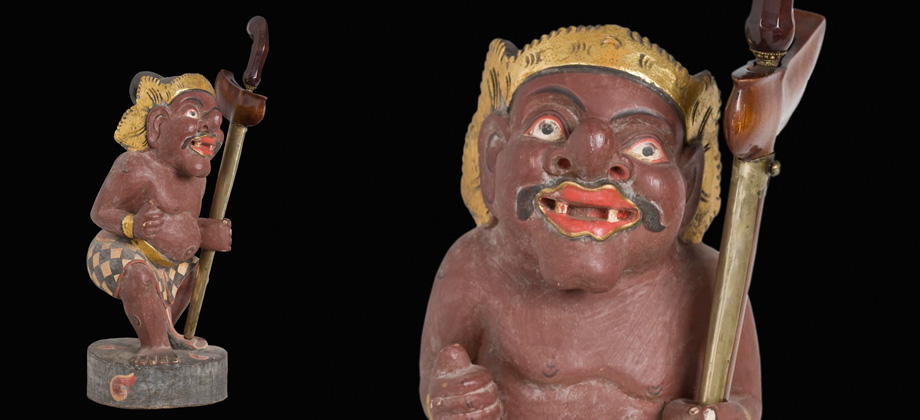
KRIS, Dagger
Settings: 19th century. Blade: 18th century
Indonesia
Iron, whale bone, gold-plated silver, silver
Full Length: 49 cm. Blade Lenght: 37 cm
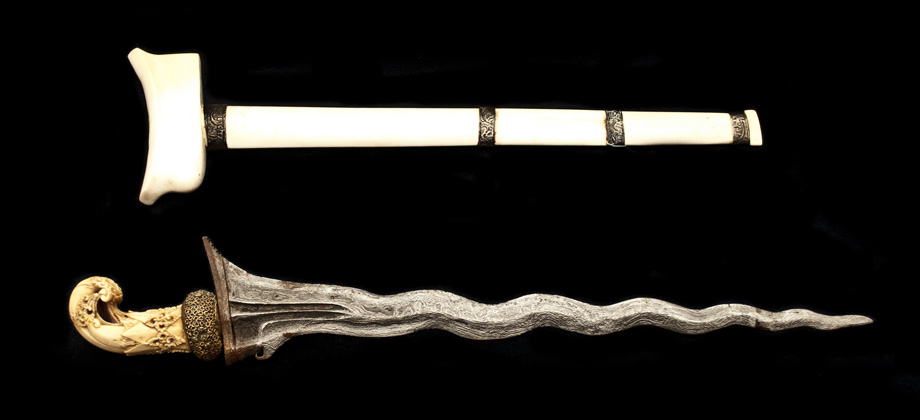
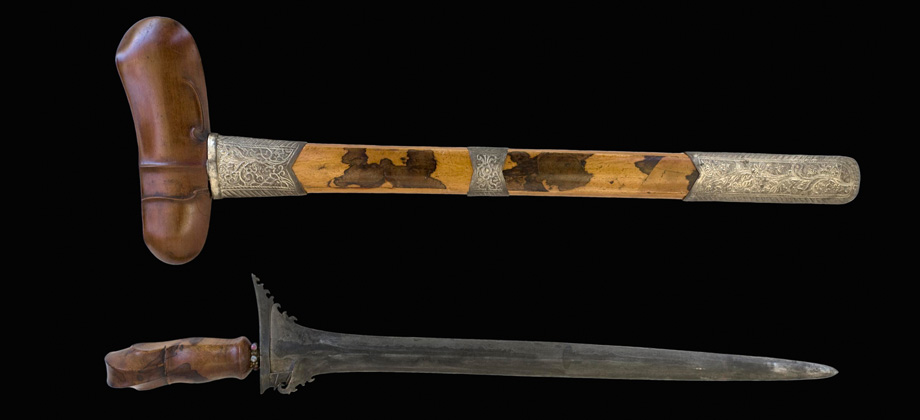
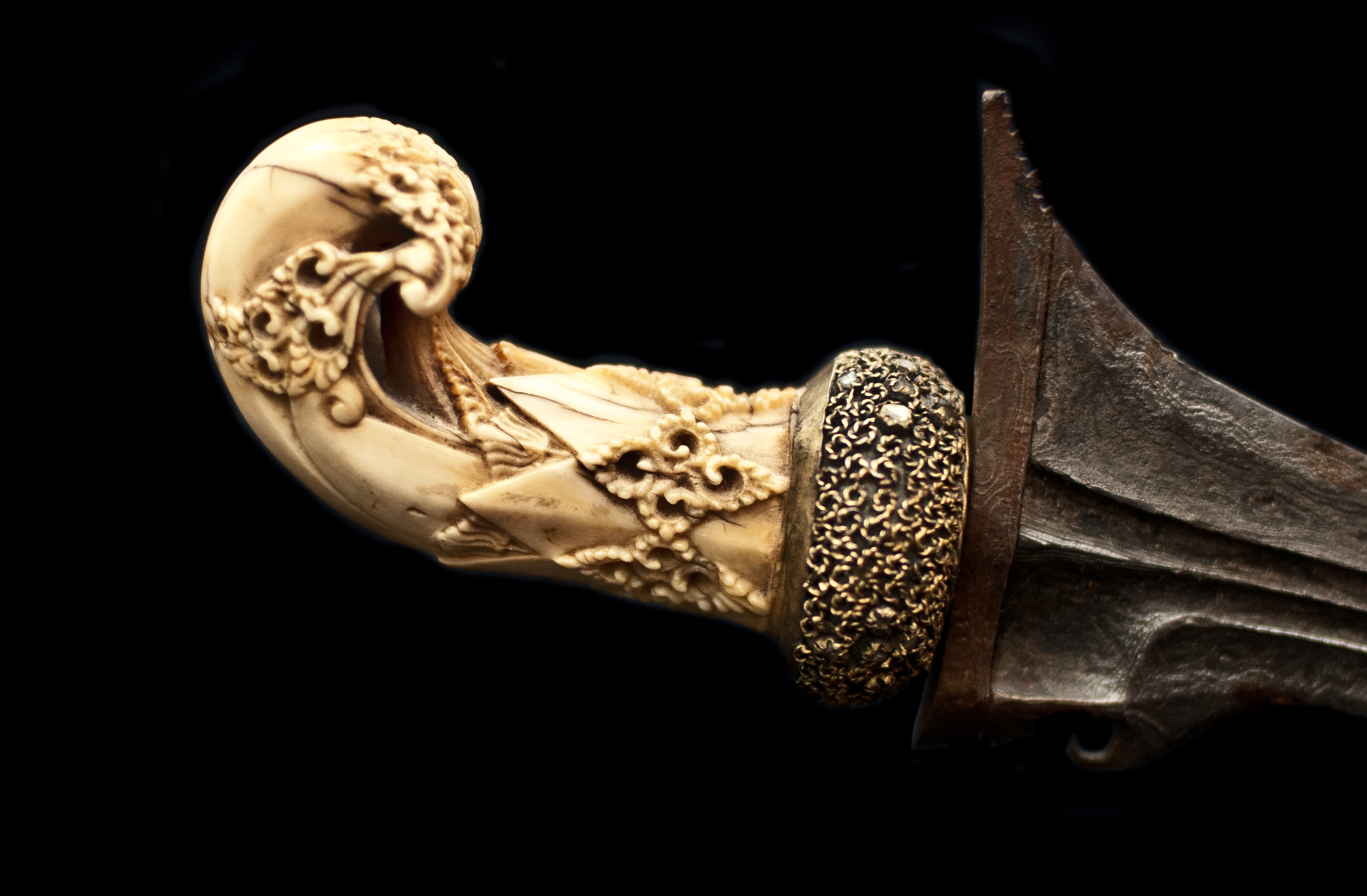
Kris from Madura, with floral ivory hilt (Hulu). The decorative ring (Mendak) between the grip and the blade is of gold-plated silver with small stones. The sheath, in whale bone, has four wrought silver rings, in K. Bahari style, with a square tip (Buntut).
The blade is waved (Dapur Luk), with thirteen curves (Sengkelat Luk). The pattern (Pamor) is intentional, parallel and resembles the rind of a watermelon (Mlumah/Rekan/Kulit Semangka).
Bibl.: Auction catalogue nº 57 Lote 3216, pag.356 2009/04/24 (HERMANN HISTORICA)
Some terminology i use:
Asal: where the BLADE is made or comes fromUmur: Age,again of the blade
Dapur: Outer shape name of the blade
Pamor: Nickle pattern design
Wranka: Ship either in fruitshape(Gayaman) or Shipshape(Ladrang)
Gandar: Wooden protector of the blade attached on the ship
Pendok: Metal sheath
Jejeran: Solo hilt
Deder: Yogyakarta hilt
Mendak: Ring between blade and hit; Malaysia: Pedongkok
Classification:
Keris Campur-means mixed material from all over the Archipel!
Asal: Java
Umur: Mataram Sultan Agung around 1630
Dapur: Sangkelat
Pamor: Beras Wutah
Wranka:Ladrang South Sumatra in ivory
Gandar: Idem with 4 silver bands
Hilt: Madura Tumenggungan type in Spermwhale Ivory with recent Selut
Trap-Trappan type in gilt metal with stones
No Mendak
Classification - Philip Hartmann
Catalogue HERMANN HISTORICA MUNCHEN, Auction 76, 4 & 5 May 2018. Page 510, Fig. 3055.
KRIS, Adaga
Montagens: séc. XIX; Lâmina: séc. XVIII
Indonésia
Ferro, osso cetáceo, prata dourada, prata
Comp. total: 49 cm. Comp. lâmina: 37 cm
Kris de Madura, com o seu punho (Hulu) em forma floral de marfim. A anel decorativo (Mendak) que está entre o punho e a lâmina é em prata dourada com pequenas pedras. A bainha, em osso de cetáceo, tem quatro anéis de prata trabalhada, do tipo K. Bahari, com a ponta (Buntut), quadrada.
A lâmina é serpenteada (Dapur Luk), com treze curvas (Sengkelat Luk). O padrão (Pamor) é do tipo intencional, paralelo e semelhante a casca de melancia (Mlumah/Rekan/Kulit Semangka).
Bibl.: Catálogo leilão nº 57 Lote 3216, pag.356 2009/04/24 (HERMANN HISTORICA)


 Click to share thisClick to share this